
What Righteousness Looks Like
Matthew introduces Joseph with a single word that changes everything: righteous.
It’s the kind of word that should settle things. Righteous people know what’s right. They follow the law. They keep the boundaries clear. When someone crosses a line, a righteous person responds accordingly.
So when Mary turns up pregnant, and Joseph knows the child isn’t his, the righteous path seems obvious. Expose her. Defend his name. Let the law do what the law does. Justice as we usually understand it: action meets consequence, sin meets judgment, the scales balanced.
But Joseph doesn’t do that.
Matthew tells us Joseph was righteous, and therefore he planned to dismiss her quietly. Not despite being righteous. Because of it.
This matters.
Before any angel speaks.
Before God explains anything.
Before Joseph has any idea that something holy is happening, his righteousness already looks like mercy.
He refuses to use his entitlement. He chooses compassion over vindication. His sense of justice doesn’t demand that Mary pay for what he believes she’s done. It protects her from the cost.
This is not a rejection of the law, but a deeper fulfillment of it. Joseph’s righteousness refuses to let judgment be the final word.
And it sounds, even from the beginning, like the God of Israel: the God whose justice has always been tangled up with mercy, whose righteousness never meant merely weighing scales but restoring what is broken.
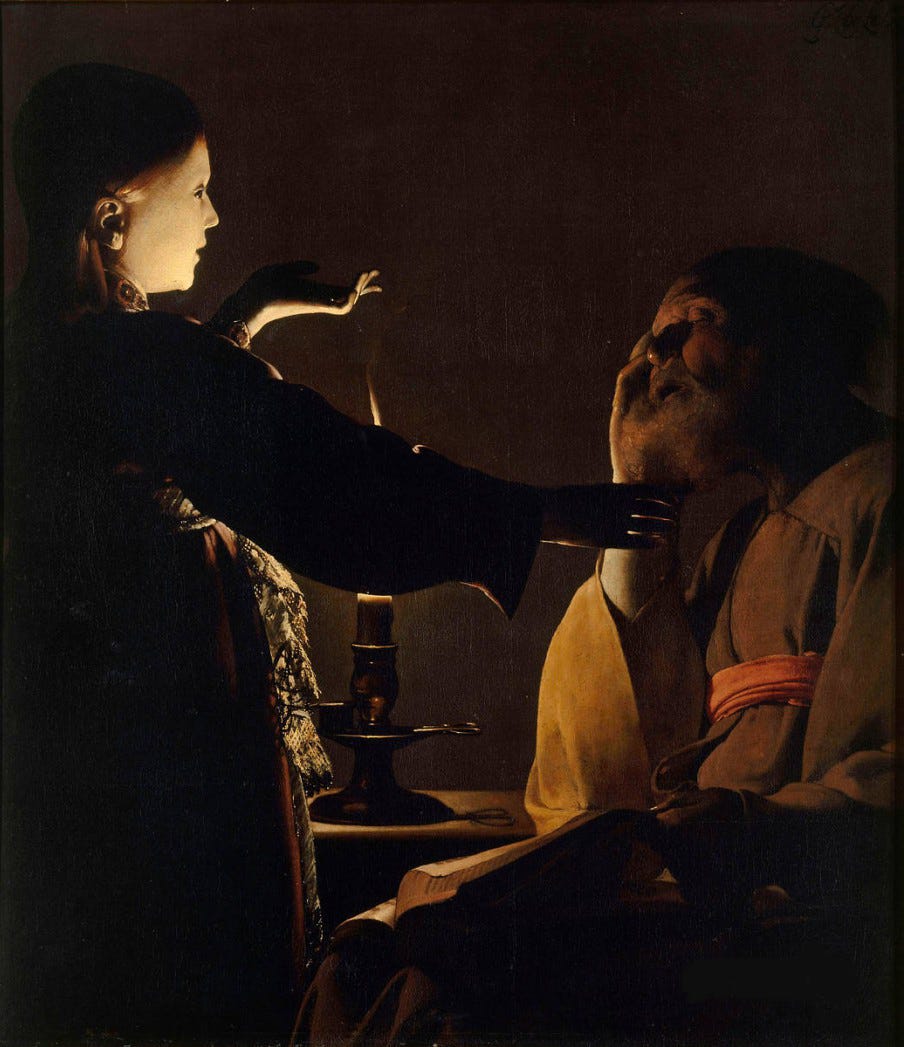
Then the angel appears.
And now righteousness takes on another shape. Joseph is told what’s happening is from God. He’s told to take Mary as his wife. To name the child. To entrust himself to a future that will not be explained in advance.
He’s not given clarity. No explanation of how this will unfold or what it will cost. No promise that people will understand or that his reputation will survive intact. Just a word from God and a call to trust it.
Joseph wakes up and obeys.
Righteousness here is not certainty. It’s trust when the path isn’t clear. It’s obedience without full comprehension. It’s choosing God’s word over your own sense of how things ought to work, even when that word disrupts everything you thought was right.
And it’s worth noticing what this kind of righteousness risks.
Joseph could still walk away. He could still choose the safer path, the one that preserved his standing. Trust, here, does not guarantee resolution. It risks making things harder.
And yet, as real and costly as Joseph’s righteousness is, Matthew is careful about where the weight finally falls.
The center is not Joseph’s obedience.
The center is God’s action.
“You are to name him Jesus,” the angel says, “for he will save his people from their sins.”
Because this is what righteousness ultimately looks like: God keeping his promise.
God creating life where there was none.
God acting to save his people. Not because they’ve become righteous enough, but because they cannot save themselves.
Jesus will spend his life embodying this kind of justice. A righteousness that restores rather than crushes. That moves toward the sinner instead of away. His whole life will be the answer to the question Matthew has already raised: What does God’s righteousness look like? And the answer will be: mercy.
Matthew gives the child another name to make sure we understand. Emmanuel. God with us.
Not God waiting for us to get it right.
Not God keeping his distance until we prove ourselves worthy.
God with us. With the guilty, the confused, the lost. With us not only when we follow the way of life, but when we choose what destroys us.
If righteousness were only about keeping rules, this would not be good news. If justice were only the balancing of scales, none of us would survive it.
But righteousness, as God defines it, is something larger. It is God refusing to let his people go.
Even when we’re guilty.
Even when we don’t understand.
Even when we’ve chosen all the wrong things.
God with us. God saving us.
That is what righteousness looks like.1
These midweek devotionals aren’t sermons. They’re meant to complement the Sunday homily. I’ll share the sermon below after it’s preached:
Victor Hugo gives us a haunting portrait of justice without mercy in the character of Inspector Javert (Les Misérables). Javert believes righteousness means strict adherence to the law—action and consequence, offense and punishment, no exceptions. The law, to him, is clean precisely because it does not bend.
Joseph, by contrast, is called “righteous” in Matthew 1 because he bends toward mercy. Assuming Mary has betrayed him, he resolves to let her go quietly rather than expose her to public shame. Matthew does not see this as a compromise of justice, but as its truest expression.
In Matthew’s world, justice is not merely a set of scales. It is a posture of mercy. Righteousness that cannot imagine mercy is not righteousness at all.
I am running out of words .... Ben is more and more one of the great preachers of our time. He mines the scripture for its deepest theological core, and he does it with what feels like intimate knowledge of human nature.
So good. Thank you.