
What Is Anglicanism?
Episode 1: The Whole Inheritance

I taught a five-week class on Anglicanism at St. John's Park Slope this spring. I thought it went well. Afterwards, as usually happens, I kept thinking of better ways to explain things than I managed in the room.
I was going to turn it into a podcast. Maybe I still will. For now, I’m posting it here.
New piece every Tuesday. Here’s episode one.
The Meal You Came to Watch
Picture yourself standing in a parish church in England, somewhere around the year 1549.
You have been coming to this building your whole life. Your parents were married here. You were baptized at that font. And for all of it, the holiest moment of the week has happened somewhere you cannot quite reach. Up past the screen, at the far end, the priest with his back to you, the words in Latin. At the highest moment a bell rings and he lifts the bread over his head, and you look. That is what you came for. Not to eat, to see. The meal is the priest’s. For people like you it is something to gaze at, from a distance, with a year between the times you taste it yourself. Holy, yes, and truly so. But sealed off. Happening to you more than with you.
And then one Sunday it is different.
It is in English now. Your English, spoken out loud where you can hear it. The thing that always happened up there, away from you, is suddenly being said to you, in words you know. And the bread and the cup are coming to you. Not once a year. Not for the priest alone while you look on. To you, and to the weaver beside you, and to everyone in the room, again and again. You hear the Gospel read out, the same Gospel as always, in your own tongue instead of Latin. You can follow it. You can pray it back. It belongs to you now.
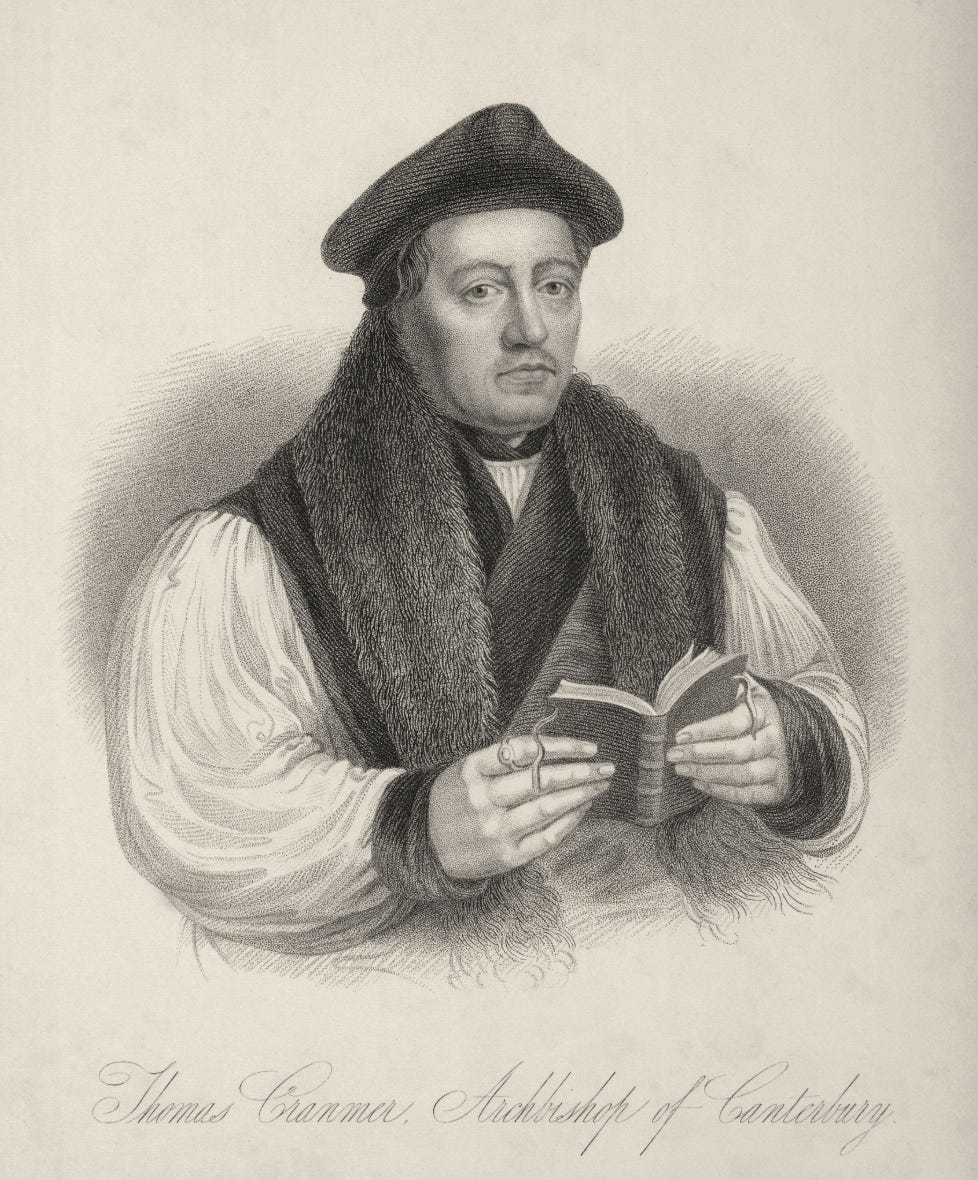
That is the moment this whole series is about. The week the holy thing stopped being watched from a distance and got handed out, in a language you could follow, to people like you. And the man who engineered it spent the last hours of his life with the same hand he used to write it all, held steady in a fire.
His name is Thomas Cranmer.
Opening the Boxes in the Attic
Welcome. This is a series about Anglicanism. What it is, where it came from, and why a tradition this particular has managed, for five hundred years, to hold together Christians who, at times, can barely stand to be in the same room.
Let me say at the start what I am not doing. I am not going to argue that Anglicans solved Christianity and everybody else got it wrong. That is not the spirit of this. What I love about this tradition is almost the opposite of that. It is a tradition that has had the nerve, more than once, to admit it got something wrong, and to keep going anyway. That kind of honesty is rare, and we will keep running into it.
Start with the word itself. Anglicanism is younger than almost everything in this story. In Cranmer’s century they would have said the Church of England, the Ecclesia Anglicana, and nothing more. The badge, and the ism on the end, only come into common use three hundred years later, in the eighteen hundreds, when a man named John Henry Newman and his friends reach for the word to argue about what this church essentially was. We will meet him. It is the word we have, so I will use it the whole way through. But for almost everyone we are about to meet, it would have been a word from the future.
So this is a look back in order to look forward. We will spend most of our time in the past, but not the way you move through a museum, with glass between you and the things on display. More like opening the boxes in the attic of a house you have just inherited, because some of what is in them you are going to want to use. There are things here we have half forgotten, and recovering them might do something to us. Not just inform us. Form us. That is the hope.
And it starts with one man, handed an almost impossible job.
The Man with the Impossible Job
Thomas Cranmer was the Archbishop of Canterbury, the most senior bishop in England, through the most volatile years of what we call the English Reformation. He served under King Henry the Eighth, then under Henry’s young son Edward, and finally, briefly and fatally, under Mary.
Here is the problem that drove everything he did. He is looking at a whole nation of people who have inherited the Christian faith the way you might inherit a language you never learned to read. They have the rituals. They have the buildings. Those things matter, and they are not the problem. What most of them do not have is the faith itself in a form they can take hold of, understand, and live. So Cranmer spends his life on a single question. How do you get a living faith, the real thing, into the hearts and the mouths and the ordinary weeks of an entire people?
His answer was not one thing. It was three. And for some time now, we have been quietly forgetting two of them.
Three Gifts, Not One
Let’s start with the one you have probably already heard of.
When most people picture Anglicanism, they picture a book. The Book of Common Prayer. And they are right to. It is Cranmer’s masterpiece, and it earns its fame. Think about what it did. It took the prayer of the church, which had belonged to the clergy and the professionals, and it put it into the mouth of the whole congregation, in their own language, in words so good that people have been praying them for nearly five hundred years. The same prayers, in the same rhythms, spoken by a duchess and a dairy maid in the same parish on the same morning. Common prayer. A common people, praying as one. If you love the Prayer Book, you are loving something worth loving. I love it too.
But this is the heart of the first episode. The Prayer Book was never meant to travel alone. It came as part of a set. Cranmer handed the English church three gifts, on purpose, and they were always meant to work together. And somewhere down the line we kept the famous one and mislaid the other two.
The second gift was preaching. Cranmer helped produce something called the Book of Homilies. These were sermons, fully written out and authorized, to be read aloud in churches across the country. Why go to that trouble? Because a great many priests at the time simply could not preach. Many had never been trained to, and would not have known where to begin. And Cranmer’s response tells you everything. He did not shrug and let the sermon quietly disappear. He said, in effect, the Word has to be preached, even here, even by a priest who cannot write his own, so we will write the sermons for them and make sure the preaching happens. That is how essential he thought it was. He built preaching in as part of the foundation, not as decoration laid on top of the service.
The third gift was theology. Cranmer was the engine behind a document called the Articles of Religion. And the Articles are the church saying, out loud, here is the shape of what we believe. Clearly enough that you can know where you stand and what you have joined. The conviction underneath them is that what you believe matters, that Christian truth has a shape, and that the church owes its people the honesty of saying so.
So hold all three together. Prayer. Preaching. Theology. The famous book, and the two we mislaid. You will meet Anglicans today, good and serious ones, who talk as though preaching is an optional extra and theology is suspect, and the real heart of the thing is the liturgy alone. I understand the instinct. But that was never the whole of what we were handed. It was a third of it. The recovery I am hoping for, across this whole series, begins right here. We need all three. We always did.
Handing Over the Treasure
And underneath all three, feeding them, is the Bible.
This is where you see what he was really after. He was on fire to get the words of Scripture into the hands and the ears of ordinary people, in a language they could follow, so the faith could come alive in them. When he built the daily morning and evening services, he built them as engines for reading the Bible out loud, the whole thing, or nearly all of it, straight through over the course of a year, the Psalms prayed all the way through every single month. He had inherited a church that gave people Scripture in tiny broken scraps, and he said, no, they will have all of it. He even wrote the preface to the great English Bible that was set up in the churches, and he called Scripture the most precious jewel and most holy relic on earth. That is how he talked about putting the Bible in front of people. Like handing them a treasure.
So put the whole thing together. The prayers, the preaching, the teaching, and the Scriptures running underneath all of it. Cranmer did not pile all of that up for its own sake. He was reaching for one thing, and it took all of it to get there. A faith alive in a person, in mind and heart and body. Not a book on a shelf. A pulse.
The Balm
So what was the message he was so desperate to deliver? When the Word is finally read and preached and prayed in a language people can follow, what is it they are meant to hear?
At the center of it is the most freeing news a human being can receive, and I do not want to rush past it, because most of us need to hear it again this week.
It is this. You are not made right with God by your performance. You do not climb to God on the ladder of your own goodness, because that ladder has never once reached the top and it never will. You are made right with God as a gift, received by faith, on the basis of what Christ has already done for you. Finished. Before you cleaned yourself up. Before the week went well or badly.
And Cranmer did not just teach this. He built it into the way people pray, in a moment that is still in our services today. After the confession of sin, after the assurance that you are forgiven, he had the priest turn to the whole congregation and speak what he called the Comfortable Words. Sentences of Scripture, spoken straight at people like a hand laid on the shoulder. “Come unto me, all you that labor and are heavy laden, and I will give you rest.” That is grace, set right into the bloodstream of the service, week after week. Not earned. Handed over.
So let me hand it to you, because it is exactly as true now as it was then. Most of us, if we are honest, are still secretly running the performance program. Still keeping a private tally. Still suspecting that God’s posture toward us rises and falls with how we did this week. And the news Cranmer wanted in front of every plowman and washerwoman in England is the news I want in front of you. It is not about the tally. It never was. Grace comes first. Before the demand, before the improvement, before you are ready. That is the balm.
One quiet note for the road, because it matters later in this series. This good news, that we are put right with God by grace and not by our performance, is something Anglicans never end up throwing away. It stays. There are stretches ahead where the emphasis tilts toward holiness, toward what it actually looks like to grow and change, and we will follow those carefully when we get to them. But the balm is never set aside. It is the floor the whole house stands on.
Dead Faith or Living Faith?
Which brings me to the idea I want to run underneath this entire series, so listen closely, because everything else hangs on it.
Cranmer said there are two kinds of faith.
There is a dead faith. Sometimes it is simply agreement. You would pass the quiz. You believe, in a quiet and settled way, that God is real and the creed is probably true, and that is not nothing, but it sits in a box on the shelf of your life, next to your politics and your hobbies, and it touches none of them.
And dead faith has another form, and around here it might be the more common one. It is the faith of culture and class and habit and belonging. You come for the music, or the people, or because your family always has, or because church is the kind of thing a respectable person does on a Sunday. The conventions, the vestments, the comfort of a familiar room and knowing exactly where to stand and when. None of that is bad in itself. But none of it is alive, either. You can have every bit of it and still carry a faith that has never once cost you anything or changed anything.
Cranmer’s own blunt example is that even the demons have a kind of faith. They know perfectly well that God is real. It changes nothing in them.
And then there is what he calls a “lively faith.” A living faith. And here I have to be careful, because this is the easiest thing in the world to hear wrong. A living faith is not a faith that has done enough. I am not about to hand you a checklist and ask whether you have produced the right amount of good behavior. That is just the performance program again, smuggled back in through the side door, and it would undo everything we just said about grace. So hear me. This is not a measurement.
A living faith is a faith that has come alive and gotten into everything. It is not one item on the shelf. It is the thing the whole shelf is now arranged around. It is in your inner life, your longings and fears and the state of your heart before God, and it is out in the open too, in how you treat people and what you do with your money and whether any of this ever leaves the building. Not because you are grinding away to prove something. More the way being in love changes how you spend an ordinary Tuesday. It is not a duty you perform. You have become a different person, and it shows up everywhere, and you could not keep it in a box if you tried. Nobody in love stops to ask whether they are loving enough. They are simply caught up in it. That is a living faith. It grows the way a planted thing grows, because it is rooted down in grace, and a thing that is truly alive cannot help showing it.
Now I want to name what all of that stands against, because it is the engine of the whole series. A living faith is the opposite of dead religion, and dead religion is a particularly Anglican temptation. We are very good at the respectable version of it. But the next part matters most. That deadness does not belong to one party. A high church parish can be stone dead behind the incense and the gold, and a low church one just as dead in its plain meeting room. Nobody has cornered the market on a living faith, and nobody is safe from losing it. It cuts straight across.
So this is the claim, and I am going to spend the rest of the series testing it against the history. Every renewal movement in Anglicanism, the high ones and the low ones, the ones that looked nothing alike and sometimes could not stand each other, was reaching for the same thing. A living faith. Whenever the church went dry and respectable, somebody stood up and said, this was supposed to be alive. And that somebody might be a fiery preacher at the low end, or a devout priest at the high end, or a scholar fighting to keep the faith honest in the face of new learning, and they would have argued about almost everything. But they were all reaching for the pulse. We are going to watch them do it, episode after episode.
The Family Meal
Come back for a moment to where we started. The bell, the lifted bread, the meal you came to watch.
Cranmer’s conviction that this faith was meant to be alive also meant it could not be hoarded. So he did two things that were radical at the time, and they grow from the same root.
First, everything in the language of the people. Like the other Reformers across Europe, he insisted that worship happen in a tongue the congregation actually understood. Because how is a faith supposed to come alive in you if you cannot follow a word of it?
And second, remember the meal you used to watch from a distance. He pressed hard on Communion, the sharing of the bread and the wine, so that it stopped being a thing the priest did while everyone looked on. The whole congregation receiving. And receiving both the bread and the cup, not the bread alone. And often, where it used to be once a year. Every Sunday, if Cranmer could have his way. The table was not a clergy privilege, and it was not a sight to adore from the far side of the screen. It was the family meal, and the family is everyone.
You can see one instinct running through all of it. This is for everyone. The Bible is for everyone. The prayers are for everyone. The table is for everyone. A living faith does not stay locked behind the screen. It gets handed out.
Fences and the Edge of the Kingdom
I want to be honest about one more thing before we end, because it runs underneath this whole series.
A faith that gets handed out to everyone still has edges. The moment you say this is what we are, you have also said, quietly, here is where we stop. And a church has to decide, again and again, who it can actually hold inside, and who, in the end, it cannot.
We are going to watch that question come up in nearly every episode, and watch it cost something every time. We will meet Puritans who cannot abide a surplice and a kneeling rail, and who finally walk out rather than pretend. We will meet a great movement of open-air preachers, on fire with the new birth, who spill over the edges and become their own church, the Methodists. We will meet a brilliant Oxford man who spends years trying to show that this church is every bit as ancient and catholic as Rome, and who, in the end, stops believing his own case, and leaves for Rome. The centuries differ and the reasons differ, but the question underneath does not. Who can this church hold, and who does it have to bless and let go?
And this is the Anglican move, planted right at the start by Cranmer himself, who was never quite as sure as some of his heirs that our particular shape was the only real way to be a church. We draw the lines we honestly have to draw. We hold them with conviction, because a thing with no edges is not generous, it is just shapeless. But what lies on the far side of those lines, we hand over to God. The Christians out there beyond our fence are not strangers and not enemies. They are family we happen not to share a roof with. We do not mistake our own fence for the edge of the kingdom.
The Fire and the Empty Hand
Which brings us, finally, back to the fire.
When the Catholic Queen Mary came to the throne, she set about undoing the Reformation, and Cranmer was condemned. In his last weeks, worn down, isolated, facing death, Thomas Cranmer did something that does not look heroic at all.
He caved. He signed recantations. More than one. He put his name to documents taking back the very things he had spent his life building. The Archbishop of the English Reformation publicly denied the Reformation. It is one of the lowest moments in our whole history, and I am not going to dress it up. He failed.
And then something turned in him. On the day of his execution, the authorities expected one last public surrender. Instead, in front of everyone, he took it all back. He repudiated the recantations, declared his real faith one final time, and said that the hand which had signed those false papers, his own right hand, would be punished first. And when they brought him to the fire, he held that hand out into the flames and kept it there, steady, until it was gone.
At the very start I mentioned a fire, and a hand held steady in it. This is that moment. I waited until now because I wanted you to meet the living faith first, before you watched it tested.
Look at what is happening there. This was a man whose own courage had already failed him, completely and publicly. He had nothing left to stand on. No record, no consistency, no heroism, nothing he could hold up to God and say, look what I did. And he did not need one. The whole message he had spent his life pressing on every plowman and washerwoman in England was that you are not made right with God by your performance, but as a gift, on the basis of what Christ has already done. And here, at the very end, with empty hands and a ruined record, Cranmer was held by the exact grace he had preached. His faith was real, and it flared back up at the end, alive, but that living faith was not something he achieved. It was the empty hand, and grace was what filled it. He was not held because his faith was strong. He was held because a love that had taken hold of him long before would not let go of him now. Not after the failure. Not after the recantations. Not after any of it. He was kept.
And do not watch that from a safe distance, as if it happened to someone else a long time ago. You have your own recantations. The thing you swore you believed and then did not live. The morning your own nerve gave out. The news Cranmer spent his life trying to press into hands like yours is the same news that held him at the fire. You are not kept because you hold on. You are kept because the love that took hold of you will not let go. There is a balm in Gilead.
That is the inheritance. The Prayer Book, the preaching, the theology, the Scriptures running under all of it, every part of it carrying that same grace, all of it handed to a whole people, in their own tongue, and into their own hands.
Next time, we will watch what happens when this tradition has to figure out how big its tent can be. Because almost the moment Cranmer is gone, the arguing starts. And it turns out the arguing is not a flaw in Anglicanism. It might be one of the truest things about it.
Thanks for listening. I’m glad you’re here.
Wow! As a non-Episcopalian, I had no clue about this.