
The Last Thing They Saw
For Ascension Day

The last thing they saw was blessing.
Not a warning. Not a command. Not a rebuke for all they had misunderstood or failed to do. Not even one more explanation, though there was still so much they could not yet grasp.
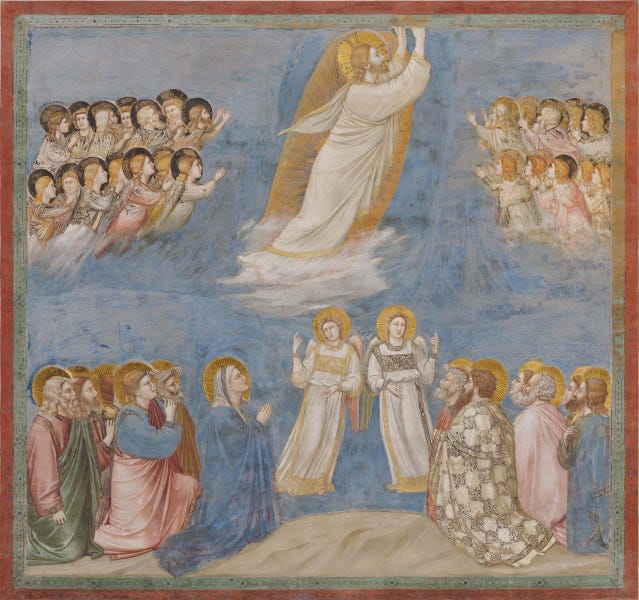
Jesus lifted his hands and blessed them.
That is how Luke’s Gospel ends.
The disciples had seen those hands do many things. They had seen them touch the sick, welcome children, break bread, and reach toward the unclean. They had seen those hands bound, pierced, and hanging. They had seen them, somehow, alive again.
And now those same hands are raised over them.
The Ascension looks like departure. A strange vanishing. The end of his nearness.
What looks like departure is really the widening of his blessing.
Jesus does not withdraw from his disciples in disappointment. He does not leave them with a burden they must carry alone. He does not ascend with his back turned toward them. He departs with his hands raised in blessing.
Before they preach, they are blessed.
Before they understand the full shape of their mission, they are blessed.
Before they are clothed with power from on high, they are blessed.
Before they do anything for him, his hands are lifted over them.
That matters because most of us live as if blessing comes only after demand. We wake beneath the weight of what must be done, repaired, endured, or held together. We assume that blessing comes afterward, if it comes at all. After we have proven ourselves. After we have become faithful enough, strong enough, useful enough.
But the risen Christ raises his hands over people who had fled, doubted, misunderstood, and grieved. He blesses them not because they are ready, but because he is gracious. Not because they have finally become worthy, but because he has joined himself to them forever. Not because they know how to follow him, but because he refuses to let them go.
And the hands raised over them are still human hands.
Jesus does not shed our humanity like a garment he no longer needs. The Son of God carries our flesh into the life of God.
Our nature is not discarded. Our wounds are not foreign to heaven.
The one who blesses from the right hand of the Father is the same Jesus who walked the road, ate the meal, touched the suffering, wept at the tomb, and showed his scars. He is not less human now. He is humanity healed, humanity glorified, humanity at home.
That is why the disciples return to Jerusalem with great joy.
Not because they have lost him. Not because they understand everything. Not because the world has suddenly become safe. Jerusalem is still Jerusalem. Their mission will not be easy.
But at the right hand of God, there is not a stranger. There is Jesus.
In heaven itself, there is a human life, crucified and risen.
And the hands that were raised over them in blessing have not come down.
Over the church, over the world, over every frightened and unfinished life, his wounded hands remain raised in blessing.
So the Christian life begins where the church begins. Not with our grasp on him, but with his mercy over us. Not with our ability to ascend, but with the astonishing news that he has ascended for us.
The last thing they saw was blessing.
And you are standing under those hands now.
Almighty God, whose blessed Son our Savior Jesus Christ ascended far above all heavens that he might fill all things: Mercifully give us faith to perceive that, according to his promise, he abides with his Church on earth, even to the end of the ages; through Jesus Christ our Lord, who lives and reigns with you and the Holy Spirit, one God, in glory everlasting. Amen.
Collect for Ascension Day (1929 Scottish Prayer Book; 1979 BCP)
GRAUNTE we beseche thee, almightie god, that like as we doe beleve thy onely-begotten sonne our lorde to have ascended into the heavens; so we may also in heart and mind thither ascende, and with him continually dwell, who liveth and reigneth with thee and the holy Ghost, one God world without end. Amen.
Thomas Cranmer’s Collect for Ascension Day (edited from its 8th century form)
These midweek devotionals aren’t sermons. They’re meant to complement the Sunday homily. I’ll share the sermon below after it’s preached: