
Someone Always Pays

There’s no such thing as a free lunch.
I learned this week that the saying comes from 19th-century saloons that actually gave the lunch away. You heard that right. A whole spread, ham and cheese and pickles and crackers, yours for nothing, as long as you bought the beer. The catch was the salt. Everything came salted heavy, so you’d get thirsty, and you’d drink more than you meant to. What looked like a deal was too good to be true. The free lunch was never free. It just made you pay on the other end.
We all know this. Nothing is free. Someone always has to pay.
The other day I went to the Brooklyn Botanic Garden because it was free, and I know some of you were there too. There was a block party, great food, good coffee, games for the kids, and you couldn’t help thinking, this is amazing. Then you noticed the clipboards. The info tables. And you realized the whole point of it was to sign up new monthly donors. I don’t hold that against them. I run an old institution myself, and you have to pay for it somehow. The garden doesn’t pay for itself. Someone’s always got to pay.
Now I’m not trying to baptize your cynicism. I’m trying to name something we’ve all been trained to know since birth: there’s always a catch. If it sounds too good to be true, it probably is. Just think of the last time your kid asked for the password to download a free game. Then the credit card bill shows up at the end of the month with sixty-five dollars of charges for whatever a “skin” is.
And it’s not just the small stuff. The oldest objection to faith is more or less this one. That grace is the free lunch we made up because we couldn’t stand the bill. A God who loves you no matter what, forgiveness you didn’t earn, the guilty eating for free? That’s exactly the kind of thing a scared person invents. And honestly, part of me hears the word grace and still waits for the catch. Because I’m not sure I’ve ever gotten something for nothing in my life.
We meet that same suspicion in our Old Testament lesson. God’s people are a long way from home, exiles in Babylon, and the worst part is that they put themselves there. They admit it. They deserve it. All hope looks lost, the math all against them. And then God cuts in, bursting onto the scene to speak to these people, the ones who have earned nothing:
Come, all of you who thirst, come to the waters. And you, the one with nothing in your pockets, you come too. Come buy wine and milk, without money, without price. Come and buy.
That sounds like a free lunch. It felt like one to God’s people too. And we are rightly suspicious, because someone always has to pay.
Our Gospel lesson is bound up with Isaiah’s. You know the story, the feeding of the five thousand. A lot of us get hung up on whether it really happened. Is it a magic trick? I believe God can still do a new thing, so I have no trouble with the miracle. But the miracle isn’t the point. The point is what these two readings, set side by side, want us to see. In both of them you have people who are hungry. People who feel dislocated, impoverished, longing for meaning and purpose and somewhere to belong.
The crowd holds onto Jesus’ every word all day, until they are actually hungry, and still nobody wants to leave. The disciples say, send them away to buy food. Jesus says, you give them something to eat. And they say, come on, we’ve got five loaves and two fish. Jesus doesn’t argue with the math. He just feeds them, food and drink like in Isaiah. All free of charge. Or so it seems. Listen closely: “Taking the five loaves and the two fish, he looked up to heaven, and blessed and broke the loaves, and gave them to the disciples.” The same words he would use at his last meal, the night before the cross. That is the good news Isaiah and Matthew are both pointing at. The message of the cross. Jesus paid it all.
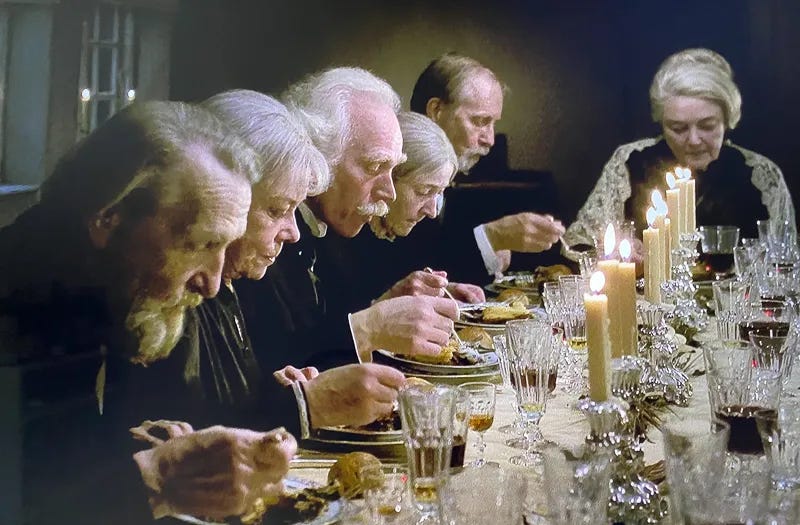
There’s a picture of this in Babette’s Feast, the Danish film that won the Oscar for Best Foreign Language Film back in 1988. Babette flees Paris as a refugee. Her husband and son have been killed, and she arrives in a small Danish village with nothing. Two aging sisters take her in, the daughters of the pastor who founded the village and its church. The congregation is old and shrinking, down to a dozen people, and there isn’t much life left in it. They worship together on Sundays and spend the rest of the week nursing grudges about one another.
Babette cooks and cleans and buries their dead for fourteen years, and she is never really paid, just given a place to stay. Then one day she wins the lottery. Ten thousand francs. To say thank you, she asks if she can cook the village a proper French dinner. This severe little congregation agrees, but they meet in secret and make a pact not to enjoy it. They have been taught that pleasure is wasteful at best and dangerous at worst.
Babette cooks, and the pact does not survive the meal. Somewhere between the soup and the quail, forty years of grudges start to come loose. Two men who hadn’t spoken in years begin telling each other the truth. An old woman who had been wronged, long ago, reaches an understanding with the man who wronged her, and forgives him. By the end of the night they are holding hands and singing, and every one of them goes home without knowing what it cost. The two sisters come into the kitchen to say goodbye, sure that now, with her winnings, Babette will go home to Paris. She tells them no. She spent all of it. The whole ten thousand, on one meal. And they are floored.
Was it wasteful? Or did it change everything?
Friends, you were right all along. There’s no such thing as a free lunch. Someone always has to pay. But what Isaiah and Matthew are pointing to, what we see in Christ, is a free gift that came at enormous cost. And the best part is that he would do it again. All for you. All for love.
In a moment you and I are going to share that lunch. And if you’re afraid it’s too good to be true, be assured: it cost someone everything. By the power of the Spirit, this gift will do in you what lectures and criticism and unsolicited advice never could. Just as it did for exiles by the water, five thousand in a deserted place, and a dozen villagers in a Danish kitchen, may this costly gift give birth in you to a love that gives itself away.
Legit one of your top 3. I pulled the car over to take notes.