
I Will Not Leave You Orphaned

The fear beneath so many fears is that, in the end, we will be left alone.
Not merely lonely. Not merely without company. But abandoned in the deepest sense. Left to carry our grief, our guilt, our future, and ourselves without anyone coming for us.
That is the fear Jesus speaks into on the night before his death.
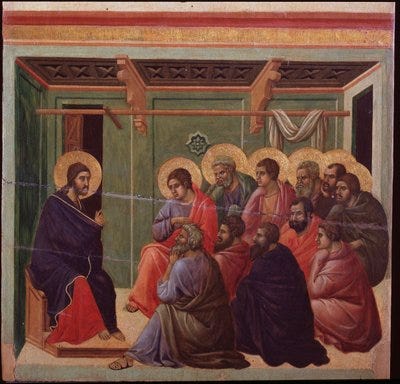
The disciples do not yet understand what is about to happen. But they know something is wrong. Judas has gone out into the night. Peter’s denial is coming. Jesus has told them he is going away. The room is heavy with dread, and his words do not make the dread vanish.
He has just told them to love one another as he has loved them. At first that sounds like one more burden placed on already-troubled hearts. As if he were saying: When I am gone, prove it. Hold it together. Be faithful enough. Do not fail me.
But that is not what he is doing.
The love he commands is the love he has already lived: love that kneels with a towel, love that stays at the table with betrayers, love that keeps moving toward the ones who will not hold on to him. He is not setting a standard. He is making a gift.
And then he tells them he is leaving.
And that they will not be left.
The Spirit is not a substitute. Not a lesser arrangement made because nothing better was possible. The Spirit is the way Jesus comes nearer than before. Until now he has been with them. Soon, by the Spirit, he will be in them.
“I will not leave you orphaned; I am coming to you.”
An orphan had no advocate. No inheritance. No home. Jesus is promising all of it.
That is the heart of it. He does not tell them the next hours will be easy. He tells them they will not be abandoned.
He is not promising help from a distance. He is promising a life joined to his own. The disciples in that room did not yet know how to hold such a promise.
But the promise holds.
There are seasons when Christ feels absent. When prayer seems to vanish into the ceiling. When the room grows dark.
But absence is not the same as abandonment.
The Spirit bears witness to the presence we cannot always feel. Christ comes to us not always as immediate relief, but as the One who refuses to let us go.
“I will not leave you orphaned.”
That is not a command to feel less afraid. It is a promise spoken into fear.
You are not left to save yourself. You are not left to keep yourself faithful. You are not left to manufacture the presence of God.
The Father gives the Spirit. The Son comes to his own. The life of God makes its home in the afraid.
“I will love him and reveal myself to him.”
Not to the world as spectacle. But to frightened people around a table.
This is still how he comes. To ordinary rooms. To troubled hearts. To those who fear they have been left alone.
Not always with explanation. Not always with relief.
But with himself.
These midweek devotionals aren’t sermons. They’re meant to complement the Sunday homily. I’ll share the sermon below after it’s preached:
Whew. Amen.